
Wells Tech Academy · 2026 Edition
Institutional Prospectus
Professional Certificate in Full-Stack Software Engineering
This publication is the official statement of Wells Tech Academy — our educational philosophy, programme standards, learner journey, and admissions process. It is intended for serious applicants who wish to understand the institution before applying.
- Programme
- Applied Software Engineering
- Duration
- 6 Months
- Accreditation
- CPD Accredited Programme
- Admissions
- Applications Open
- Next Cohort
- 22 August 2026
01 — Letter
A Letter from the Academy
To the prospective learner,
Wells Tech Academy is a CPD-accredited UK institution for career changers pursuing professional technology capability through structured formation, live instruction, and earned graduation.
The Academy publishes its standards, fees, and admissions process. Completion means demonstrated competence against the Graduation Standard — not attendance alone.
Wells was established for determined adults from warehouse, care, retail, administration, and non-technical graduate backgrounds who are ready for structured professional formation.
Read the full philosophy publication for the Academy's complete educational conviction.
Software engineering deserves the same seriousness as any professional discipline. It requires structured formation, accountable practice, and evidence of competence — not shortcuts, spectacle, or passive consumption of content.
Wells Tech Academy was created for learners who intend to practise engineering with discipline. This prospectus explains how we approach that responsibility.
02 — Philosophy
Our Educational Philosophy
We do not believe software engineers are formed through memorisation or tool familiarity alone. Capability is built through understanding, practice, review, and delivery — under guidance, with accountability.
Building as professional practice
- Deployable work.
- Production delivery.
- Professional workflows.
- Accountable outcomes.
Live formation with accountability
- Live instruction.
- Practitioner review.
- Cohort structure.
- Published assessment.
Preparation for professional practice
- Portfolio evidence.
- Professional communication.
- Disciplined delivery.
- Honest career preparation.
Institutional Commitments
- Live instruction from practising engineers.
- Structured curriculum with published progression standards.
- Published graduation standards — completion is earned, not assumed.
- Meaningful code reviews against professional engineering criteria.
- Professional feedback on submitted work and engineering decisions.
- Project-based engineering producing deployable software.
- Continued mentorship through and beyond the programme.
- A respectful learning environment held to professional standards.
03 — Audience
Who This Programme Is For
The Applied Software Engineering is demanding by design. It suits learners who are prepared to participate actively, accept professional feedback, and sustain effort across six months of structured instruction and independent work.
Ideal Learner
- Committed to attending live sessions and completing independent practice.
- Prepared to learn through building, reviewing, and revising real software.
- Willing to communicate professionally with instructors and cohort peers.
- Motivated by professional capability — not a certificate alone.
- Able to sustain a significant weekly commitment beyond scheduled sessions.
Who May Find The Programme Demanding
- Learners who expect passive video consumption without active participation.
- Those unable to commit regular time to labs, projects, and revision.
- Applicants seeking a surface introduction to coding without professional standards.
- Learners unwilling to receive structured feedback and revise their work.
Entry Readiness
- A reliable laptop and internet connection for live online or hybrid sessions.
- Professional communication and honest disclosure of your availability in your application.
- Preparedness to attend live sessions and complete assessed work throughout the programme.
Prior professional coding experience is not required for Applied Software Engineering.
04 — Journey
The Programme Journey
The learner journey spans admissions, orientation, structured instruction, assessed delivery, graduation, and continued mentorship. Each stage has a defined purpose within the academy's model.
Admissions Pathway
- 01
Submit Your Application
Share your background, objectives, preferred delivery mode, and readiness through the published application form.
- 02
Admissions Review
The Admissions Office reviews programme fit, delivery preferences, and cohort availability.
- 03
Admissions Conversation
Where appropriate, a structured conversation may help clarify expectations, tuition, and next steps.
- 04
Offer, Enrolment & Onboarding
Successful applicants receive a formal offer, confirm acceptance, complete tuition arrangements, and receive enrolment guidance.
Programme Progression
You Arrive
You enter a cohort held to professional standards — prepared to participate actively throughout formation.
Learn
Live instruction, labs, and structured curriculum develop engineering foundations under practitioner guidance.
Build
Project sprints and code reviews produce real software — version-controlled, reviewed, and improved iteratively.
Deploy
Applications reach production environments with cloud deployment, configuration, and operational discipline.
Present
Portfolio, case studies, and Graduate Exhibition present capability as professional evidence.
Graduate
Completion is earned against the Graduation Standard — demonstrated capability, not attendance alone.
Continued Mentorship
Twelve months of structured mentorship supports your transition into professional practice.
After Acceptance
- Accepted learners receive enrolment guidance and pre-programme preparation instructions.
- Portal access is provisioned through My Academy, where orientation materials and cohort information are published.
- First-access setup establishes secure sign-in and profile completion before the cohort begins.
- Orientation introduces delivery expectations, platform navigation, and programme standards.
05 — Learning
The Learning Experience
Professional capability is learned by doing — under guidance, with accountability.
Wells Tech Academy delivers learning through live, synchronous instruction — designed for engagement, application, and professional feedback.
The methodology mirrors how technology professionals work: structured instruction, hands-on application, collaborative review, and iterative delivery toward milestones.
Cohort members participate in a professional process — present, accountable, and held to the published Graduation Standard.
A typical week combines live instruction, workshops, practitioner review, project sprints, mentorship, and collaborative development.
Live Instruction
Structured lectures, live coding demonstrations, and interactive discussion.
Hands-On Labs
Dedicated application time with instructor support and immediate practice.
Code Review
Professional feedback on quality, readability, and maintainability.
Project Sprints
Time-boxed delivery toward curriculum milestones and capstone goals.
Peer Collaboration
Pair programming, team discussion, and cohort problem-solving.
Office Hours
Direct access to instructors for technical questions and mentorship.
Weekly Rhythm
The programme allocates 360 guided learning hours across six months, with 240 hours of structured independent study and project work.
Live Sessions
Instructor-led lectures, demonstrations, and technical discussion — synchronised across the cohort.
Lab Time
Hands-on application of concepts with instructor availability and peer collaboration.
Code Review
Structured submission and feedback cycles on learner work against professional standards.
Project Work
Sprint-based delivery toward weekly deliverables and phase milestones.
Office Hours
Optional dedicated access for individual questions, clarification, and mentorship.

06 — Curriculum
Curriculum Overview
Six stages. One disciplined progression.
The Wells Formation Model is visible at a glance — from professional foundations through capstone delivery and Graduate Exhibition. Learners progress through stages, not week numbers.
Professional Foundations · Stage I
Development environments, programming fundamentals, version control discipline, and professional communication.
Frontend Engineering · Stage II
Component architecture, accessible interfaces, state management, and user-centred frontend delivery.
Backend Engineering & Data Systems · Stage III
API design, relational data modelling, authentication, validation, and full-stack integration.
Professional Software Engineering · Stage IV
Architecture discipline, CI/CD, cloud deployment, operational awareness, and responsible AI-assisted workflow.
Professional Engineering Studio · Stage V
Team-based product delivery under realistic constraints — shared codebase, iterative delivery, and stakeholder demonstration.
Capstone, Career Accelerator & Graduation · Stage VI
Independent capstone, career preparation, Graduate Exhibition, and graduation panel review.
07 — Standards
Professional Standards
Professional standards apply from the first session. The programme mirrors the expectations of engineering teams — attendance, communication, submission discipline, and integrity in all work.
Attendance Expectations
Live instruction is central to the programme. Learners are expected to attend scheduled sessions across their chosen delivery mode.
- Minimum 85% attendance of scheduled live sessions
- Active participation in labs, workshops, and code reviews
- Hybrid and online learners must attend synchronised cohort sessions
- Absences require advance notice and catch-up commitment
Project Milestones
Weekly deliverables and sprint commitments define accountable progress through the curriculum.
- Submitted deliverables at the end of each curriculum week
- Sprint-based project milestones during capstone phases
- Incomplete milestones addressed before progression to next phase
- All work maintained in version-controlled repositories
Code Reviews
Instructor-led code review cycles teach quality, readability, and maintainability as professional requirements.
- Regular submission of work for structured code review
- Revision and resubmission where standards are not met
- Peer review participation during collaborative sprints
- Documentation of engineering decisions alongside code
Assessment Checkpoints
Formal reviews at phase transitions confirm readiness to advance through the programme architecture.
- Phase checkpoint at end of Engineering Foundations (Week 3)
- Full-stack competency review (Week 7)
- Cloud deployment verification (Week 9)
- Capstone scope approval before independent build phase
Completion Requirements
Graduation requires fulfilment of all programme deliverables and participation in the Graduate Exhibition.
- All four graduate portfolio artefacts completed to standard
- Capstone project deployed, documented, and presented
- Portfolio website published with programme work
- Participation in Graduate Exhibition and career action planning
Daily Accountability
Attendance
Live sessions are mandatory. Participation is recorded and absences require advance notice with catch-up commitment.
Submission
Weekly deliverables are submitted through version-controlled repositories on schedule. Late or incomplete work is addressed before progression.
Code Review Cycles
Work moves through structured review — submit, receive feedback, revise, resubmit. Quality is non-negotiable.
Sprint Accountability
Capstone and project phases operate on sprint commitments with defined milestones, demos, and retrospective reflection.
08 — Platform
The Student Experience
Learners study through My Academy — the academy's learner platform. It is not a content library. It is the operational surface for sessions, projects, feedback, evidence, and credentials.
My Academy
Your cohort dashboard, programme roadmap, and institutional communications.
Learning
Scheduled sessions, materials, and the accountable weekly rhythm of instruction.
Projects
Engineering briefs, submissions, and portfolio evidence across the programme.
Feedback
Professional review on submitted work — structured, documented, and actionable.
Certificates
Verifiable graduation credentials and CPD Accredited Certificate upon earned completion against the published Graduation Standard.
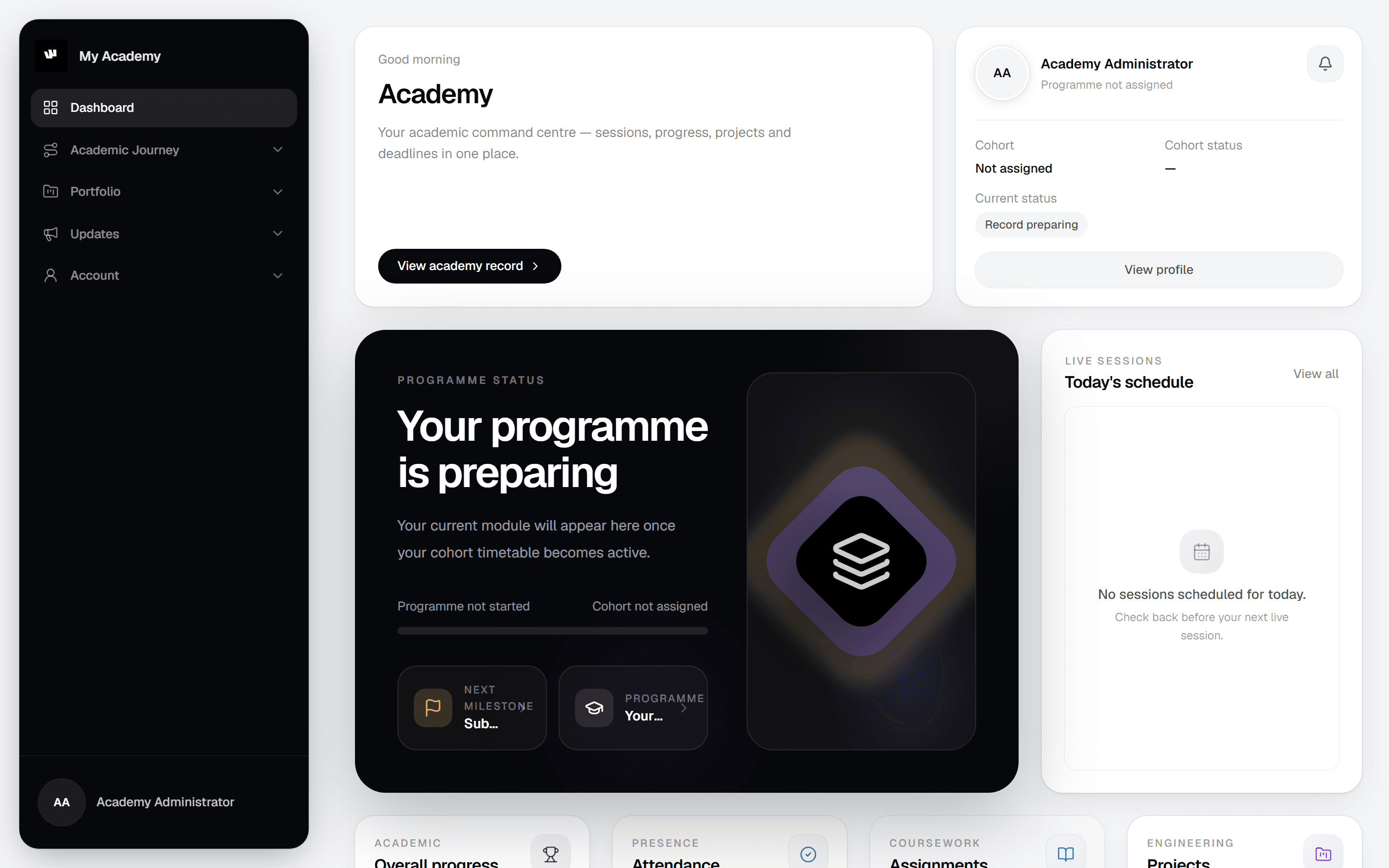
My Academy Dashboard
Cohort context, upcoming sessions, and progress signals — your daily starting point.
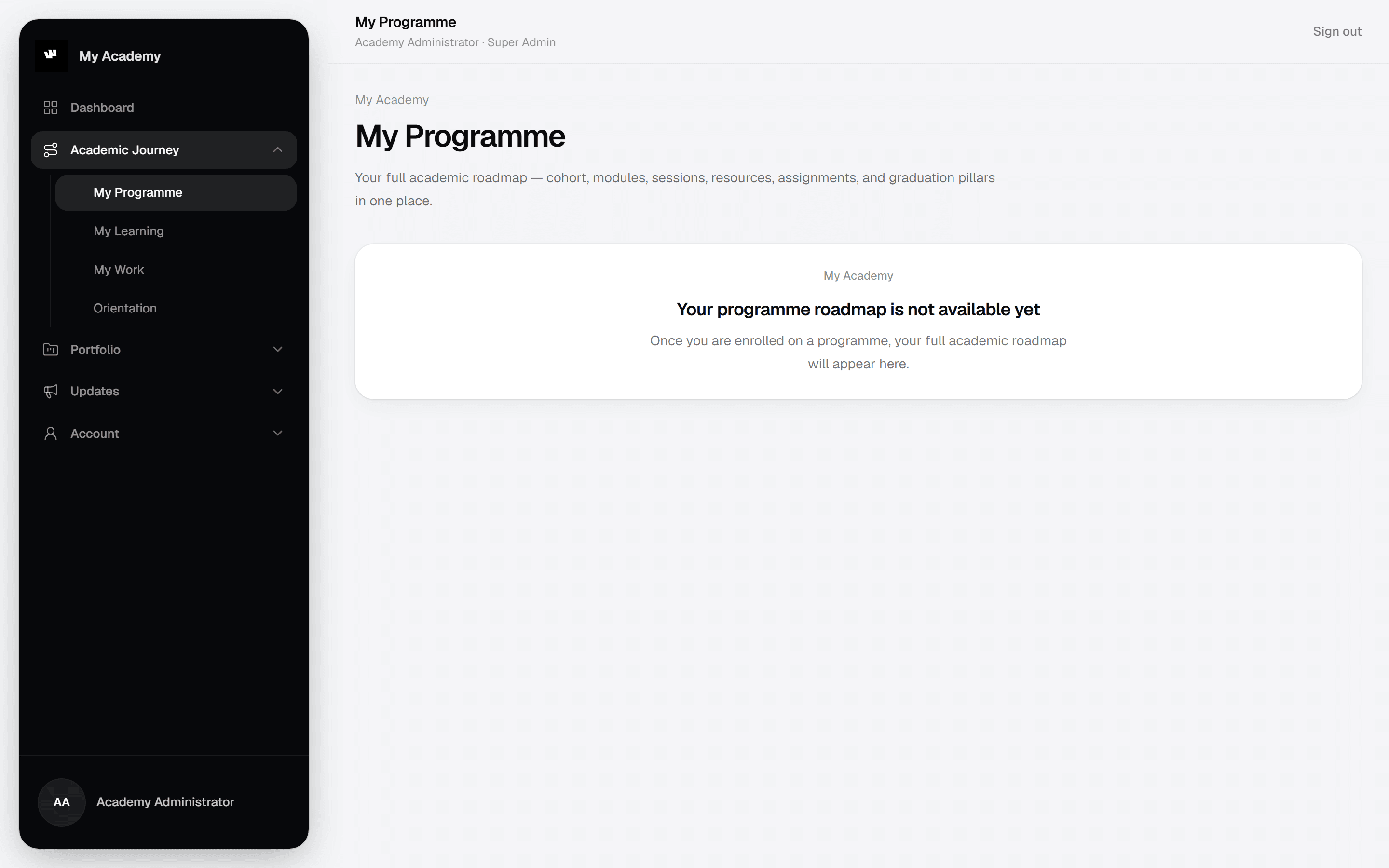
Programme Roadmap
Structured module progression with clear milestones across the twelve-week journey.
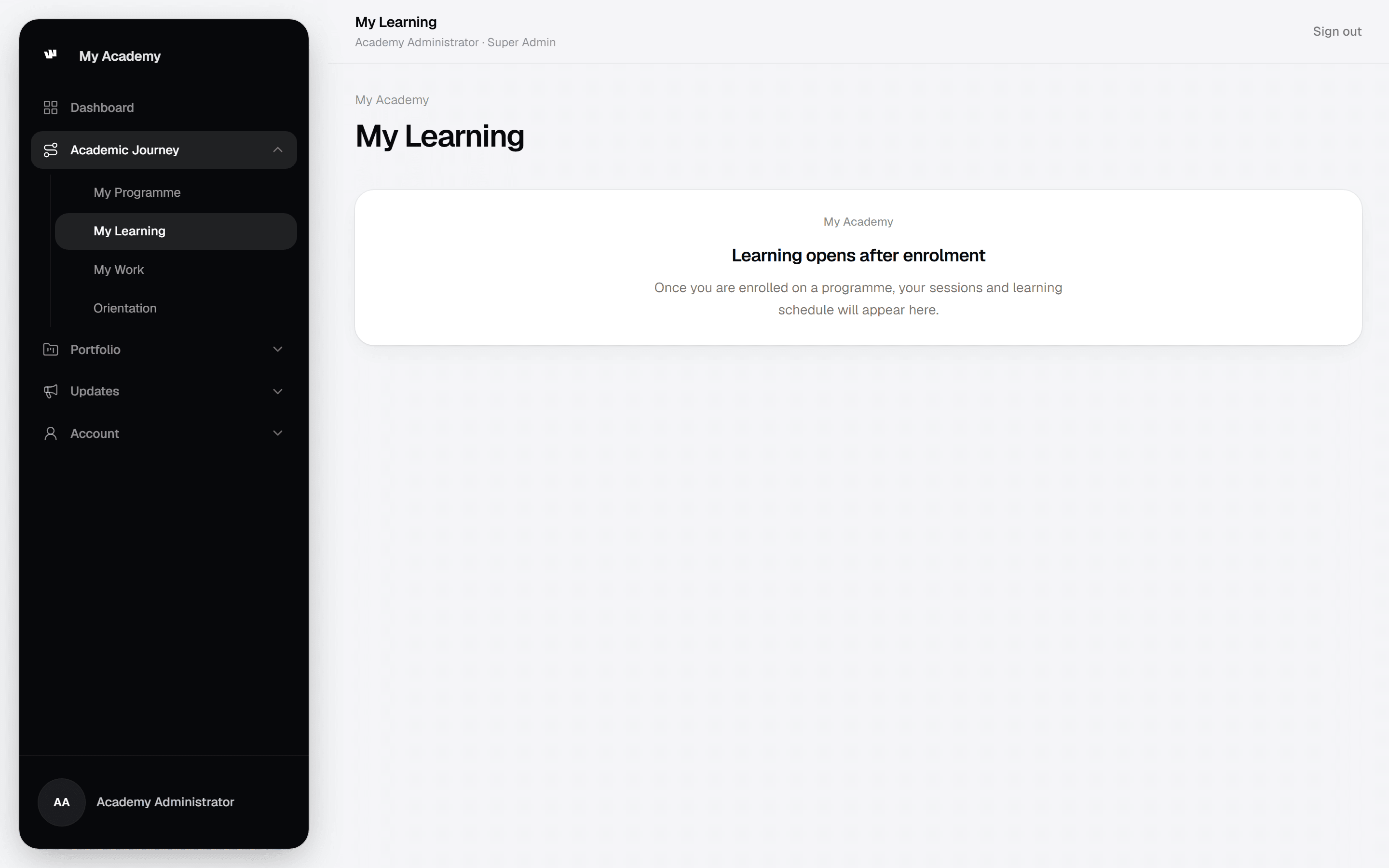
Learning Sessions
Live instruction, session materials, and accountable weekly rhythm.
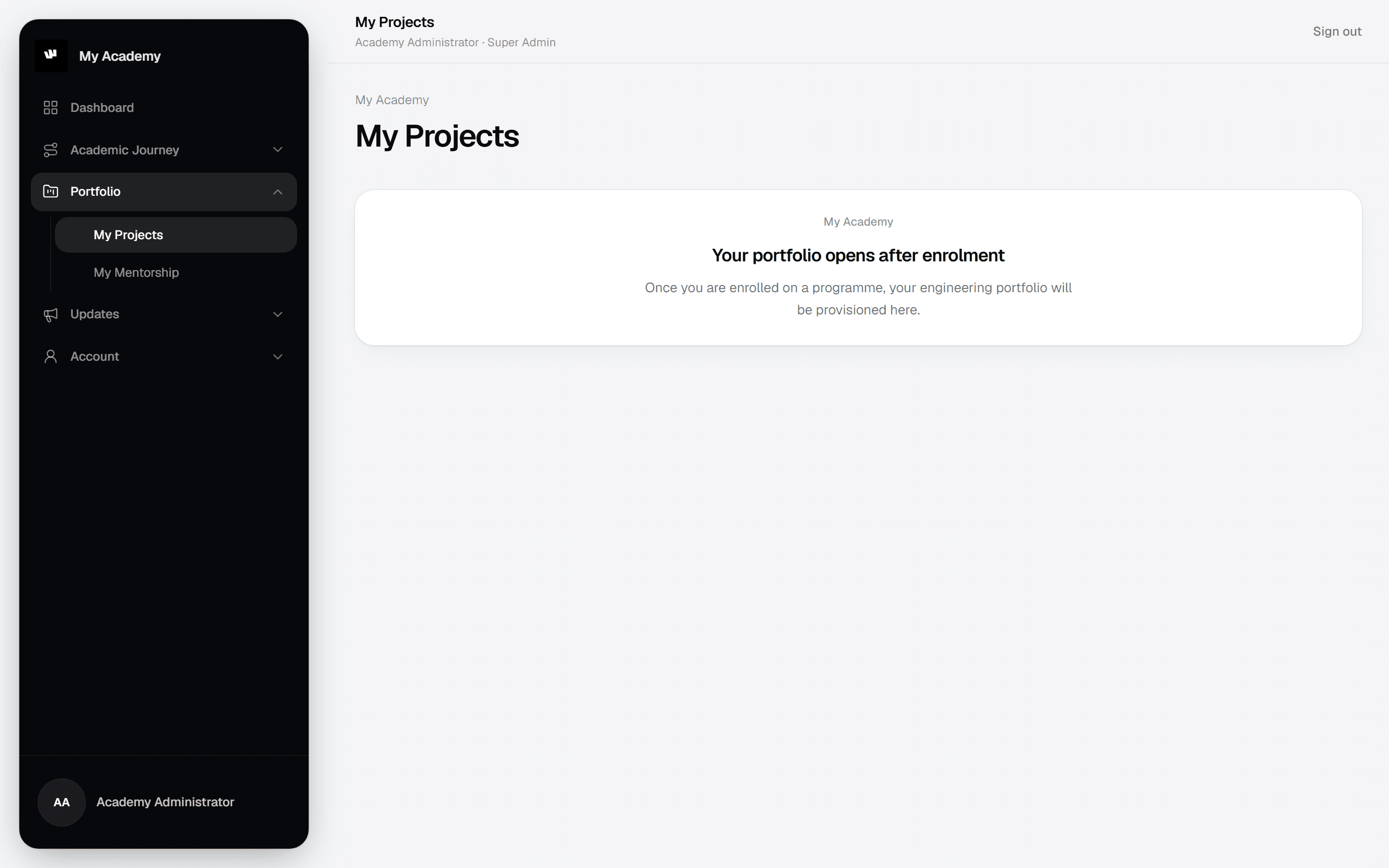
Project Portfolio
Scoped engineering projects with briefs, submissions, and portfolio evidence.

09 — Graduation
Assessment & Graduation
Completion at Wells Tech Academy is earned through demonstrated professional capability rather than course attendance alone. This standard applies across all Wells programmes — capability is verified against published evidence, not assumed from enrolment.
The Applied Software Engineering is assessed against the following evidence pillars.
Engineering Foundations
Development environment proficiency, programming fundamentals, version control discipline, and professional coding standards — evidenced through reviewed repository work and successful completion of the Stage I foundations checkpoint.
Professional Software Development
Full-stack capability across modern frameworks, APIs, databases, and authentication — evidenced through an integrated application with tested critical paths and documented engineering decisions.
Deployment & Delivery
Production deployment capability including cloud infrastructure, environment configuration, CI/CD, and operational documentation — evidenced through a live, accessible application.
Professional Readiness
Portfolio presentation, technical communication, studio collaboration, capstone delivery, and Graduate Exhibition participation — evidenced through deployed artefacts, case studies, and assessed presentation to professional standard.
Graduate Capability
Graduates develop demonstrated engineering capability — not surface familiarity with tools. Completion means you can practise software engineering with discipline and evidence.
- Designing software systems with clear architecture and intentional structure.
- Building production-ready full-stack applications using contemporary frameworks and professional workflows.
- Working within engineering environments — version control, code review, testing discipline, and iterative delivery.
- Deploying applications to cloud infrastructure with environment configuration and pipeline automation.
- Collaborating through Git with the habits expected of professional teams.
- Applying AI-assisted engineering responsibly within daily practice.
- Presenting technical work through portfolio, case study, and Graduate Exhibition.
10 — CPD
CPD Accreditation
Wells Tech Academy is a CPD accredited institution. The Applied Software Engineering carries CPD accreditation — recognising structured professional development within the United Kingdom's continuing professional development framework.
CPD — Continuing Professional Development — is the structured approach professionals use in the United Kingdom to maintain and develop capability throughout their careers. CPD accreditation indicates that a programme has been reviewed against recognised standards for professional development quality, learning outcomes, and assessment rigour.
Learner Benefits
- External recognition that the programme meets CPD quality standards for structured professional development.
- A CPD Accredited Certificate upon successful completion — alongside the Wells graduation certificate.
- A credential employers understand within UK professional development practice.
- Documentation of structured formation that supports continuing professional development records.
Employer Relevance
Employers assessing career changers often look for evidence of structured development — not only self-directed learning. CPD accreditation indicates the programme was independently reviewed; portfolio work and the Graduation Standard demonstrate what the individual can build.
Certificates
Wells Graduation Certificate
Institutional certificate of completion, verifiable through the Academy's certificate verification service, issued upon earned graduation against the published Graduation Standard.
CPD Accredited Certificate
Certificate confirming accredited continuing professional development, issued subject to successful programme completion against the Graduation Standard.
Successful graduates receive the Wells Graduation Certificate and a CPD Accredited Certificate. Both require earned completion against the published Graduation Standard. Certificates can be verified through the Academy where applicable.
CPD accreditation recognises programme quality and structured development. It records formation completed to an externally reviewed standard; professional registration, where a role requires it, is a separate matter.
11 — Questions
Frequently Asked Questions
What does graduation mean at Wells Tech Academy?
Graduation is earned completion against the published Graduation Standard — demonstrated engineering capability verified through deployable artefacts, code review, and Graduate Exhibition participation. Attendance alone does not constitute completion.
How long does the programme take?
The Applied Software Engineering runs for six months, comprising 360 guided learning hours and 240 independent study hours beyond scheduled sessions.
What is the weekly time commitment?
Approximately twenty to twenty-three hours combined guided and independent work per active week, varying by formation stage.
Do I need prior coding experience?
No prior professional coding experience is required. Applicants should be prepared for structured learning, regular independent practice, and consistent participation throughout the programme.
Can I study online?
Yes. Live online delivery is available with the same instructor-led curriculum and programme standards as in-person and hybrid modes.
Can I study while working?
Many learners balance professional commitments with the programme. Hybrid delivery is often selected by working professionals. Expect a significant weekly commitment beyond scheduled live sessions.
What equipment do I need?
A reliable laptop with stable internet access is required. Online and hybrid learners should ensure their setup supports live video sessions and development work throughout the programme.
Is continued mentorship available after graduation?
Yes. The programme includes 12 months continued mentorship beyond programme completion, supporting career transition and professional development.
How are applications reviewed?
Every application is reviewed by our admissions office to assess programme fit, readiness, delivery preferences, and support needs before enrolment is confirmed.
What happens after I apply?
You receive confirmation of receipt. Admissions reviews your application and typically responds within two business days. Suitable applicants receive guidance on fees, delivery options, and enrolment steps.
What is the programme tuition?
Published programme tuition for the Applied Software Engineering is £2,250. This is stated in the prospectus, on the admissions page, and during application review. Payment plans may be available for eligible applicants.
Are payment options available?
Payment plans may be available for eligible applicants. Admissions advisors can discuss available options during the application and review process.
How are certificates awarded and verified?
Certificates are issued upon earned graduation against the published standard. Graduates receive the Wells Graduation Certificate and, subject to successful completion, a CPD Accredited Certificate. Credentials can be confirmed through the academy's certificate verification service.
What is CPD accreditation?
CPD — Continuing Professional Development — accreditation recognises that a programme delivers structured professional development to an externally reviewed standard. It indicates quality of learning design, delivery, and assessed outcomes.
Is the Applied Software Engineering CPD accredited?
Yes. The Applied Software Engineering at Wells Tech Academy is CPD accredited.
Will I receive a CPD certificate?
Successful graduates who complete the programme against the published Graduation Standard receive a CPD Accredited Certificate alongside the Wells Graduation Certificate. Completion is earned through assessed delivery — not attendance alone.
How is CPD recognised by employers?
Employers in the United Kingdom commonly understand CPD as structured professional development. Accreditation signals that the programme was independently reviewed; your portfolio and Graduate Exhibition evidence demonstrate individual engineering capability.
Does CPD accreditation guarantee employment?
No. CPD accreditation recognises programme quality and structured professional development. Employment depends on capability, presentation, market conditions, and individual effort.
12 — Investment
Programme Investment
The Applied Software Engineering is published at £2,250 programme tuition. This figure is stated here so applicants can understand the financial commitment before applying — not as a sales proposition, but as part of the official institutional record.
£2,250
Programme Tuition
Programme Includes
- 6 Months
- 360 Guided Learning Hours
- 240 Independent Study Hours
- Live Instructor-Led Learning
- Applied Software Engineering Curriculum
- Professional Engineering Studio
- Capstone Project
- Career & Outcomes
- Portfolio Development
- 12 Months Continued Mentorship
Payment Options
We understand that applicants may prefer flexibility when investing in professional formation.
Payment plans may be available for eligible applicants. Admissions advisors can discuss available options during the application process.
Published programme tuition. Payment plans may be available for eligible applicants — discussed during admissions review, not as a condition of learning the fee.
13 — Admissions
Admissions
Admissions exist to help learners choose the right programme pathway, understand the commitment involved, and begin with clarity. We review every application with care.
- 01
Submit Your Application
Share your background, objectives, preferred delivery mode, and readiness through the published application form.
- 02
Admissions Review
The Admissions Office reviews programme fit, delivery preferences, and cohort availability.
- 03
Admissions Conversation
Where appropriate, a structured conversation may help clarify expectations, tuition, and next steps.
- 04
Offer, Enrolment & Onboarding
Successful applicants receive a formal offer, confirm acceptance, complete tuition arrangements, and receive enrolment guidance.
After Your Application
- Your application is received: You receive confirmation of receipt and a reference you can use to check status.
- Admissions reviews your information: We read your background, goals, programme choice, and study preferences with care.
- Further communication where needed: Where appropriate, an admissions conversation may help clarify expectations and next steps.
- Progression toward enrolment: Successful progression leads toward a written offer, enrolment guidance, and onboarding before teaching begins.
When you submit an application, the Admissions Office receives it and reviews the information you have provided. The aim is a clear, professional next step — not a distant process.
Admissions response: Within two business days
14 — Invitation
A Final Invitation
This prospectus describes a serious programme within a serious institution.
If you have read this far, you likely understand what Wells Tech Academy asks of its learners — and what it offers in return: structured formation, professional standards, deployable capability, and continued support beyond graduation.
When you believe you are ready, we invite you to submit an application. Our admissions office will review your submission and guide you through the next steps with clarity and respect.