Programme Preview

Become a Professional Full-Stack Software Engineer

Professional Full-Stack Software Engineering — Build production-ready applications using modern professional engineering workflows.

View Full Curriculum

Why This Programme Exists

Engineering education should feel like the work itself.

Wells Tech Academy was created for applicants who intend to build production-ready software — full-stack applications with authentication, databases, APIs, and deployment pipelines held to professional standards.

The programme teaches software engineering in the AI era: modern application architecture, third-party integrations, Cursor-assisted workflows, and complete application delivery — not machine learning, model training, or data science.

Formation follows professional discipline: accountable projects, review, mentoring, and delivery standards that mirror engineering teams. Theory supports practice; it never replaces it.

Curriculum progression

From planning to graduation — one coherent engineering path.

01

Planning

02

Foundation

03

Frontend Engineering

04

Backend Engineering

05

Database Engineering

06

Cloud

07

Testing

08

AI

09

Capstone

10

Graduation

Graduate capability

Software employers recognise — because you will have built it.

  • Enterprise Authentication

    Separate learner and operations surfaces with clear access boundaries, recovery paths, and role-aware routing.

    Employers need engineers who treat identity as architecture, not a login form.

  • REST APIs

    Design and implement versioned HTTP interfaces with validation, error contracts, and documentation discipline.

    API design is how teams integrate — clarity here prevents years of integration debt.

  • Next.js Applications

    Ship full-stack React applications with server components, routing, and production-minded performance.

    Modern product teams expect fluency in contemporary web frameworks.

  • React Systems

    Compose accessible interfaces with predictable state, component boundaries, and maintainable structure.

    UI engineering is systems design at human scale.

  • Database Design

    Model relational data, migrations, constraints, and queries that remain correct under real usage.

    Data integrity is non-negotiable in enterprise software.

  • Payment Platforms

    Integrate billing flows, receipts, and finance visibility with audit-friendly communication patterns.

    Money movement demands precision, traceability, and calm UX.

  • AI Integration

    Apply AI-assisted development responsibly — prompts, guardrails, and human review in production contexts.

    Teams want engineers who augment judgment with AI, not replace it.

  • Role-based Security

    Implement authorization models where permissions follow responsibility, not convenience.

    Security mistakes are career-limiting; clarity here builds trust.

  • Admin Dashboards

    Build operational interfaces for admissions, delivery, and student success with institutional UX standards.

    Internal tools shape how organisations scale.

  • Learning Platforms

    Experience the same academy platform you will use — progress, sessions, projects, and certificates in one place.

    Self-directed learning on professional tooling mirrors industry onboarding.

  • Production Deployment

    Deploy with environment discipline, CI awareness, and the humility to monitor what you ship.

    Shipping is a skill; employers hire people who can own delivery.

  • Testing

    Write tests that protect behaviour, document intent, and survive refactors.

    Quality culture starts with engineers who test what matters.

  • GitHub Collaboration

    Branch, review, and merge with the habits professional teams expect from day one.

    Collaboration hygiene is as important as code quality.

  • Enterprise SaaS

    Capstone work targets production-grade applications — scoped, documented, and defensible in interview.

    Portfolio evidence beats course completion on every hiring panel.

From the teaser series

Ideas we share before your cohort begins.

Previews only — the full articles arrive in your inbox over the coming days.

Preview

Authentication is a boundary, not a button.

In professional systems, sign-in is a sequence of decisions — who is requesting access, which surface they enter, and what they may do once inside.

Preview

Modern software engineering is about solving problems, not memorising syntax.

Syntax changes. Architectural judgment, communication, and delivery discipline endure across stacks and teams.

Preview

Enterprise systems are built for people before they are built for computers.

Clarity for operators, learners, and users determines whether sophisticated engineering ever reaches production.

My Academy

One academic environment for your entire journey

From your first orientation to graduation, every stage of your programme is delivered through a single, structured learner environment — designed for accountability, clarity, and professional formation.

My Academy is not a content library or a software showcase. It is where your cohort meets: live classes, programme structure, project work, tutor feedback, and your verified academic record — so you always know what comes next, and the academy always knows where you are in the journey.

  1. Your programme
  2. Your classes
  3. Your projects
  4. Tutor feedback
  5. Your portfolio
  6. Graduation
Sign in to My Academy
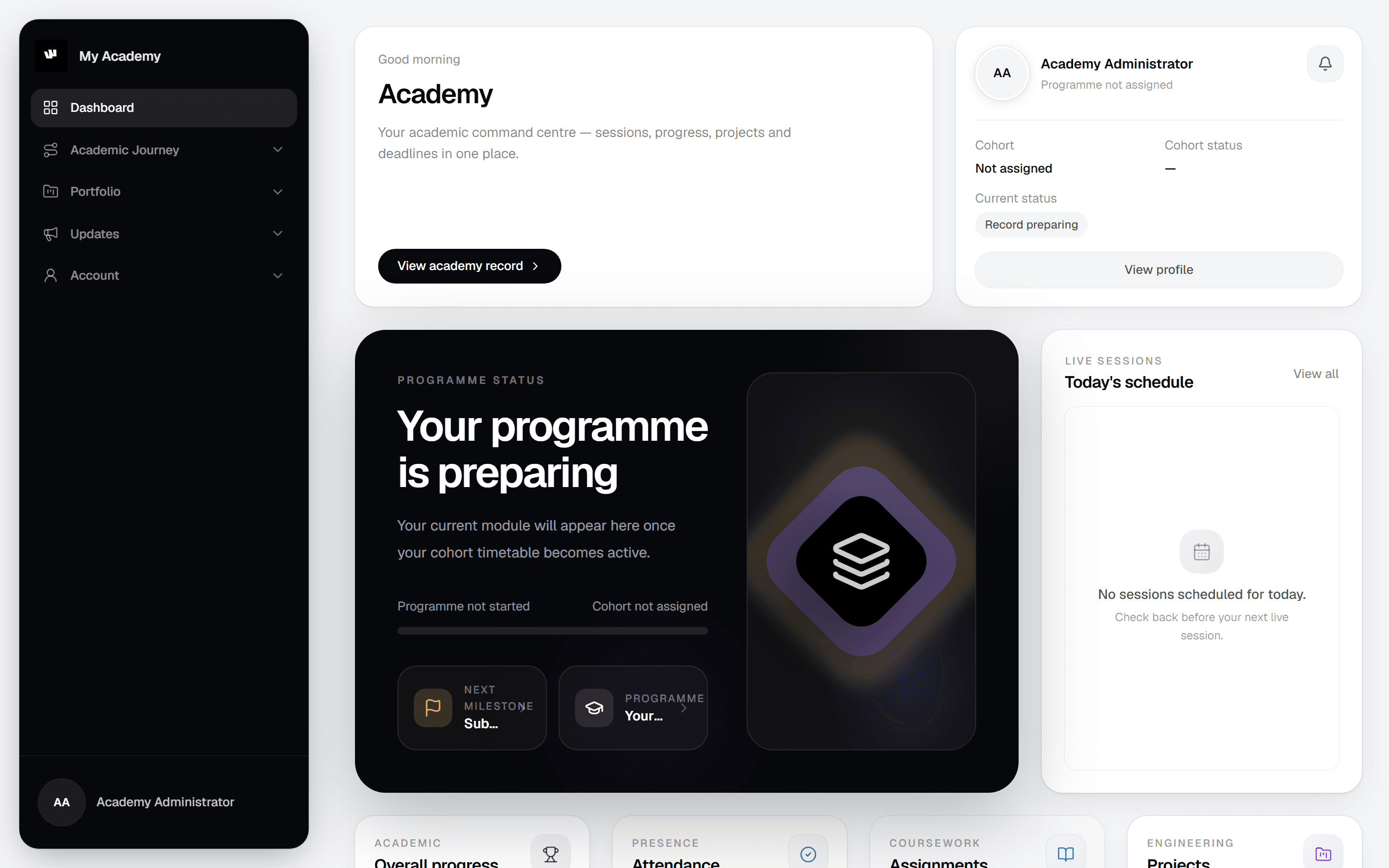
My Academy dashboard with cohort overview and learner progress

My Academy Dashboard

Cohort context, upcoming sessions, and progress signals — your daily starting point.

  • Academic journey

    Follow your complete programme roadmap — modules, milestones, and progression in one coherent view.

  • Live learning

    Join scheduled classes, access session materials, and maintain the weekly rhythm of professional study.

  • Projects

    Build production software throughout the programme — scoped briefs, submissions, and portfolio evidence.

  • Feedback

    Receive structured tutor review on your engineering work — clear expectations and accountable improvement.

  • Portfolio

    Curate work that demonstrates readiness to employers — not exercises, but evidence of delivery.

  • Certificates

    Graduate with your complete academic record — credentials issued and verified through the academy.

How you learn

Every stage is intentional. Nothing is left to chance.

Wells Tech Academy is not self-paced content with optional support. You follow a structured formation pathway — guided at every step, reviewed against professional standards, and measured by what you can deliver.

  1. 01

    Foundation

    Your cohort establishes shared engineering standards: development environment, professional vocabulary, and the discipline of prepared participation. Advanced work waits until the baseline is secure.

    You begin practice alongside peers — not in isolated self-study.

  2. 02

    Guided practice

    Live instruction and supervised exercises introduce each concept before you carry it independently. Tutors model professional thinking; you apply it within the same week.

    New capability arrives in context — never as disconnected tutorials.

  3. 03

    Real projects

    Scoped deliverables replace toy exercises. Each project connects to the last, accumulating into work you can defend in interview — not exercises filed away.

    Your portfolio begins forming from the first month of the programme.

  4. 04

    Code reviews

    Your code is read as engineering work: structure, clarity, boundaries, and maintainability. Review is not correction for its own sake — it is how professional judgment develops.

    You learn to write software others can trust and extend.

  5. 05

    Professional feedback

    Milestone reviews address delivery, communication, and engineering judgment — the qualities hiring panels evaluate. Feedback is direct, constructive, and aligned to industry expectation.

    Standards mirror the workplace — not classroom politeness.

  6. 06

    Portfolio

    Work is curated with intention: what to present, how to frame it, and why it demonstrates readiness. The portfolio is evidence — not a certificate of attendance.

    Employers evaluate shipped work, not completed modules.

  7. 07

    Capstone

    A production-minded application you own from architecture through deployment — scoped, documented, and held to the published graduation standard.

    You graduate having delivered — not having merely participated.

  8. 08

    Career preparation

    Interview readiness, technical presentation, and structured career launch support close the pathway — bridging academic formation and professional employment.

    You leave prepared to be assessed as an engineer, not a student.

You are never abandoned to figure it out alone. Each milestone prepares you for the next — until you graduate ready to be evaluated as an engineer.

Stack

Tools professional teams use — taught with restraint.

  • Next.js
  • React
  • TypeScript
  • PostgreSQL
  • Supabase
  • GitHub
  • Tailwind
  • OpenAI
  • REST APIs
  • CI/CD
  • Docker (future)
  • Cloud

Six Months

How your cohort moves from orientation to graduation.

  1. 01

    Orientation

  2. 02

    Core modules

  3. 03

    Projects

  4. 04

    Portfolio

  5. 05

    Capstone

  6. 06

    Graduation

Questions

Before you continue — answers we give openly.

Do I need previous experience?

Motivation and commitment matter more than a perfect starting point. We assess readiness during application — honesty about your background helps us support you well.

Can beginners join?

Yes, with realistic expectations. The programme is intensive and structured; beginners who invest consistent time can progress, but the pace assumes professional discipline.

How many hours each week?

Plan for guided instruction plus substantial independent practice — typically twenty to twenty-three hours weekly during active formation stages, depending on delivery mode and prior experience.

Online or hybrid?

In-person at Croydon or Gloucester, live online worldwide, or hybrid — you choose the mode that fits your life without sacrificing cohort accountability.

How long is the programme?

Six months of structured, instructor-led formation with clear milestones from orientation through graduation.

Will I build real software?

Yes. Projects, evidence submissions, and capstone work target deployable applications — the same standard we show in this preview.

What certificate will I receive?

Graduates receive a Wells Tech Academy certificate of completion with verification — awarded against our published graduation standard, not attendance alone.

Next step

Ready to Begin?

Continue your application or speak with admissions — we are here to help you decide if this cohort is the right fit.

Contact Admissions
Programme preview